
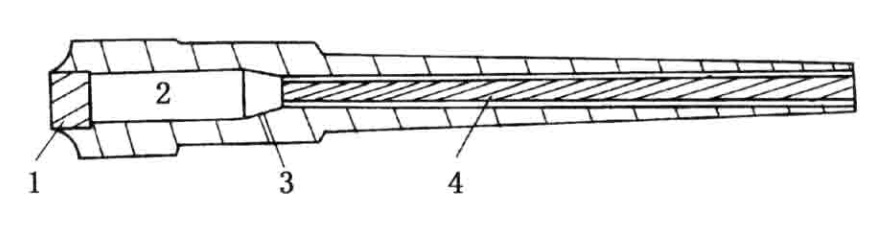
The conventional gun is constructed with, from left to right, a breech (1), that seals propellant and the combustion gas products within the chamber (2). The shoulder (& neck) (3) connects the chamber with the barrel (4), sometimes referred to interchangeably as the bore, which guides the projectile.
The Equivalent Ideal Gun
For a real firearm, obturation1 is only achieved for a portion of its travel down the barrel, or from the end of the freebore to the start of the muzzle device. The details of which, while no doubt highly of interest to gunsmiths, is of little concern to the interior ballisticians while designing the kinematics of the gun.
Additionally, as the chamber is usually somewhat wider than the barrel, the gas combustion product is constricted by the shoulder as it flows into the barrel. While this effect can be modeled (and is in fact required for accurate solution of light gas guns), the effect is small except for extreme level of necking (on anti-tank rifles, and for eargesplitten cartridges).
Neglecting both of these complications yields the “equivalent ideal gun”, where the entire chamber-and-neck section is treated as an extension to the barrel behind the projectile, with the same total volume. The projectile is treated as fully obturated at its starting position.
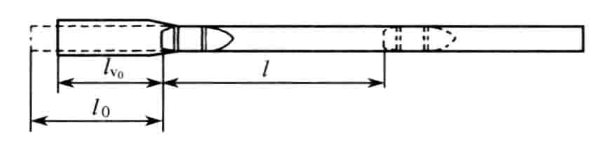
Let the chamber-and-neck section have volume 


With certain assumptions, the chamber free volume at ignition, 

The Lumped Parameter Model
The behavior of propellant combustion product behind the projectile is a complex subject, involving such phenomenons as the mixed-phase flow of uncombusted solid propellant granules entrained within the gas stream of combustion product, the errosive burning of solid propellant under the same condition which modifies the geometry in non-obvious ways, etc.
A rigorous treatment of such phenomenon is possible with the tools and techniques available today, and are used for tackling specific engineering problem associated with gun design, such as the optimization of ignition systems, validating the absence of dangerous pressure-wave systems in guns, etc., the effort and levels of detail required to construct such models by necessity confines them to the later stages of a project, where the goal is to work out the details and solve specific issues as they arise.
In the earlier stages of a project, it is desirable to ascertain the influence of general characteristics, or parameters, e.g. barrel length, caliber, chamber volume, charge and shot mass, has on the performance of the gun, such that a suitable set of these parameters may be selected as the basis for further refinement.
Historically, gunsmiths were able to come up with some reasonable set of these parameters through brute force trial and error, but as firearm became increasingly complex in the early-modern period, this became far less practicable2. Instead, models were constructed with the goal of solving the “central problem of interior ballistics”: predicting the muzzle velocity and peak pressure developed by a firearm, so-called because of its practical importance. Models parameterizing more properties, and consequently applicable across a wider range of design conditions are amplified, until in the early 20th century ballisticians settled on a standardized set of assumptions, parameters, and approaches to solving their influence on the resulting gun. Such models are known as Lumped Parameter model.
The Lagrange Gradient
By assuming the pressure behind the projectile follows certain pre-established gradient, the evolution of gas pressure behind the projectile as the combustion progress, and as the projectile is accelerated, can be characterized by some average value.
For example, the most commonly used gradient, proposed (all the way back) by Joseph-Louis Lagrange himself, assumes that the unburnt propellant mixes uniformly and travels with the propellant gas product, the density of this mixed flow is everywhere the same. This leads to the convenient relation (in an ideal gun) of the following form:

Where 


This relates the breech pressure to the projectile’s base pressure as:

Another useful quantity is the space-mean pressure, usually referred to as average pressure, which is:
![\cfrac{p}{p_s} = \int_{0}^{1} [1 + \cfrac{w}{2m} (1-z^2)] dz = 1 + \cfrac{w}{3m}](https://s0.wp.com/latex.php?latex=%5Ccfrac%7Bp%7D%7Bp_s%7D+%3D+%5Cint_%7B0%7D%5E%7B1%7D++%5B1+%2B+%5Ccfrac%7Bw%7D%7B2m%7D+%281-z%5E2%29%5D+dz+%3D+1+%2B+%5Ccfrac%7Bw%7D%7B3m%7D&bg=ffffff&fg=000&s=0&c=20201002)
In historical context, as the ratio 


In plain English, this means that the pressure at the breech is always larger than that at the projectile’s base, by an amount proporitonal to the relative mass between the projectile and the propellant. A larger load of propellant relative to the projectile tends to cause a larger difference. This is simply a consequence that the pressure at the breech must support the acceleration of not only the projectile, but also the entire column of propellant behind the projectile. This fact would have important consequence in gun design, as it dictates that adding propellant creates diminishing returns, since more of the propellant goes to propelling the added weight of the propellant rather than the projectile.
Other gradients are known, notably the Pidduck-Kent gradient, which describes the limiting state as a result of infinitely many reverberating pressure waves behind the projectile. As well, Soviet ballistician Mamontov assumed constant-temperature behind the projectile and came to a similar gradient. Although there are some theoretical argument in favor of these at large charge to shot mass ratio, the predicted results are not far from that of the Lagrange gradient even for those conditions, while the procedures are much more complicated. Consequently, the Lagrange gradient remains popular for lumped parameter models.
Propellant Thermal-chemical Properties
For lumped parameter models, it is customarily assumed that the propellant, once burnt into gaseous combustion products, is “frozen” in terms of composition. This is accurate enough for ballistics purposes, as the reaction rate drops precipitously as it begins to expand. Treating the combustion product as a mixed gas with a property that is the weighted average of its constituent species, the Nobel-Abel equation of state (EoS) is quite commonly used when dealing with pressure in the several hundred megapascal (several thousand atmospheres) range.


The thermal-chemical properties of propellant are usually determined via ballistic bomb tests, where a certain mass of propellant specimen is burned in an instrumented and enclosed pressure vessel, known as a bomb. With the propellant fully burnt, the isochoric (constant volume) flame temperature 

In Soviet (and Chinese) ballistics literature, the propellant load is written as 


With that, the maximum pressure developed inside a bomb 

Taking the maximum pressure for a number of load densities, then plotting the data points with 

And as 


Propellant Burn Rate
The de Saint Robert’s law describes the rate at which the combustion surface of solid propellant recedes, of which the Vieille’s law is a special case of:

The pressure independent term is comparatively more important for small arms cartridges, where the powder is cut quite thin (often only decimal millimeters across), and the pressure low, than for larger pieces. Propellant burn rate. The pressure referenced in these laws is usually taken to be the average pressure for propellant of fine grained geometry, although it can be reasonably argued that in reality the breech pressure may be more appropriate for heavier grains.
A historically important treatment is to take 
Propellant Geometry and Web
Propellant can be manufactured in a truly impressive variety of geometry, fortunately standardized measurement exist to reference across different geometry, in the form of a propellant’s “web”, or the shortest distance between two parallel surfaces. For a graphical representation of what this looks like for various shapes of propellant, see the below figure. Denoting propellant’s web as 
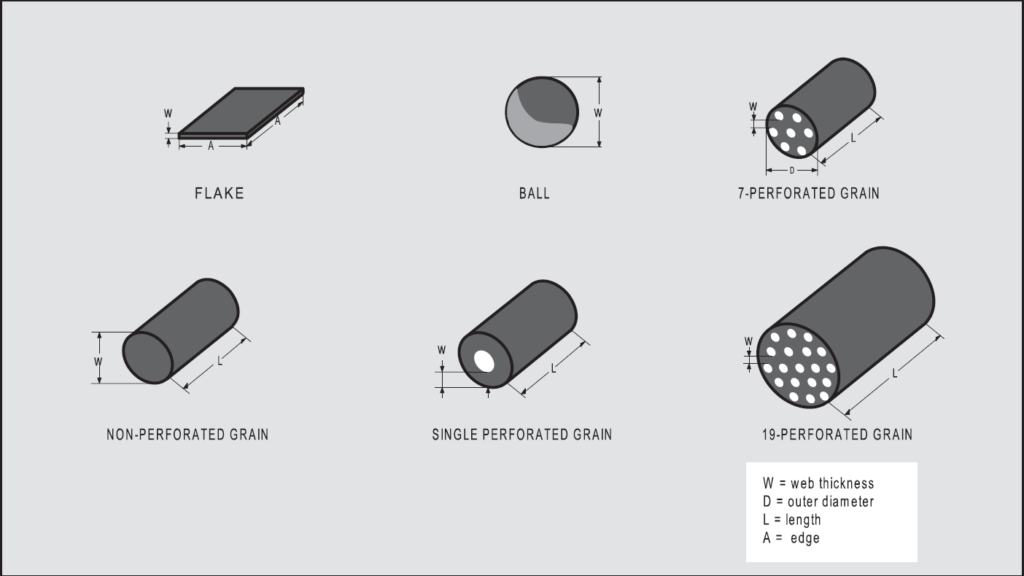
It is useful to consider how the propellant behaves as combustion progress. Assuming ignition on all surfaces simultaneously (as is tradition), the flame front is at all times parallel to the surface that was ignited. For flake, ball and non-perforated cylindrical grains, the surfaces experiencing combustion is reduced in size as the grains are burnt through. This is referred to in the field as regressive burning. The opposite effect is termed progressive burning and is chiefly experienced by multiple-perforated grains prior to their fracturing, illustrated in the figure below. The decrease in combustion area as the outer rim and the ends burn “in” is outdone by the increase in combustion area as the perforations burn “out”. Post fracturing, the irregular “slivers” of propellant, note the shaded area, does burn regressively, but as this occurs near the end of combustion, and in any case the volume of the slivers are small in comparison to the grain, the effect overall is to make the propellant behave progressively.
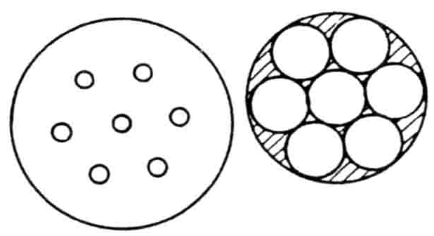
The combustion of single-perforated cylindrical grains is almost neutral, as the burning of the perforation and outer rim perfectly cancels each other out, while burning lengthwise introduces a slight regressive burning tendency.
Propllant Form Function (Quadratic)
An inexact way to capture the combustion behavior of propellant is to model the burnt fraction of the propellant’s volume, 


Some insight into this function may be gained by taking the derivative of 

Qualitatively, this maps the value of
: regressive burning
: neutral burning
: progressive burning
Quantitatively, as alluded to previously, with the exception of single-perforated cylindrical grains, the quadratic form function is only an approximation for most propellant geometries, these requiring a cubic form function to adequately describe.
Some Notes on Interior Ballistics Simplification
Much of the simplifying assumptions, previously detailed, is to allow the interior ballistics problem to be solved for pressure and velocity analytically, i.e. without resorting to numerical integration of the underlying ordinary differential equations. In simpler terms, theory of interior ballistics relates how the system’s parameters, velocity, pressure, burnup, travel, etc., vary with (let’s say) time, but going from this to a history of how these parameters evolve over time is anything but trivial, requiring either:
- finding some system of equation that happens to have a rate of change corresponding to theory, i.e. finding the analytical solution. This is expedient, but puts non-obvious restrictions on the form of equation that can be accommodated, which limits the phenomenons that can be modeled.
- propagating each parameter according to the rate of change incrementally, from the initial condition up to the desired point, i.e. numerically integrating the system to find a numerical solution. This is more relaxing on what forms of equations can be integrated, but is extremely cumbersome in practice, requiring some thousands of intermediate calculations in order to find the solution for one single set of parameter, and the intermediate results cannot be reused.
Much of the early interior ballistics work was done before the advent and widespread availability of high speed mechanical assistance to computation, and was by necessity of the first type. Consequently, a great variety of analytical models are known, commonly named after interior ballisticians associated with its compilation or publication. Even as the differential analyzer, then mechanical computer, and eventually the digital computer finally trivialized solutions of the second type, analytical solutions remained popular in some niche, notably in the prospective design of guns, which usually entail running many such calculations until a suitable solution was found.
- the projectile, machined slightly wider than the caliber, is slightly deformed to form a seal as it travels down the barrel. ↩︎
- Several notable factors include: the move from round to spitzer shots, which decoupled the shot mass from the caliber; the use of fixed cartridges instead of muzzle loading, which decoupled chamaber volume from propellant load; the increased variety of propellant available. ↩︎
- In thermodynamics term, this is the difference between the specific enthalpy and specific internal energy of the combustion gas product as the propellant is fully burnt. In layman’s term, this is the work that can be extracted per unit mass of propellant burnt, if the resulting combustion gas follows ideal gas behavior, and is expanded in an adiabatic reversible process, down to vacuum. ↩︎
- not to be confused with the projectile shape factor in exterior ballistics. ↩︎

 The Meandering of a Ballistics Oriented Mind
Leave a comment