
Introduction: Orphans of the Dead Earth
The PC video game, Children of a Dead Earth, was a fond memory of my youth. I cannot be too sure about the exact details, but I remember the game was what motivated me to set up a Steam account when I was only 14 years old. Through the game, I joined communities and met many people that had a profound and lasting influence on my future career and even personal life.
Having said that, it may surprise the reader to know that I actually feel quite bitterly towards the game. Objectively speaking, the game is quite an impressively put together piece, purporting to simulate retro-futuristic space combat with solid basis in reality, at a never before seen level of technical accuracy and detail. And for a 16 year old me, it looked the part of everything it promised.
But herein lies the problem. The expectation of the game being what it said, the illusion of technical accuracy, started cracking when players rigorously tested the game, at great difficulty. The more learned players began to raise doubts, but I remembered the sentiment at that time was largely that, while there may be some nonspecific issues the game got wrong, it was on the whole accurate.
The feeling of uncertainty was compounded by, ironically enough, useful technical information being deprived from the player through poor choices made in the design of the user interface, which given the game’s infamy among the more casual audience as a “slider and number hell”, is quite ironic. As an example, the laser module would tell you how much fluence the laser can put out at a given range, but nowhere is it in game that you can find information that relates this to how fast it will drill through a given configuration of armor. In fact, the only way of gauging the performance of a given armor design was and is to build an entire inert, engine-less craft with it, and test it out in a custom battle. It wasn’t the end of the world, sure, and helpful members of the community would soon pool their effort over hours of rote testing, compiling spreadsheets and graphs to help guide other players. At the time I remember thinking that these type of utilities felt like such little effort for so much potential player frustration avoided.
But the more paranoid side of me to this day still wonders if this wasn’t exploiting human psychology, by making it harder to observe the intermediate steps, it made both reverse-engineering how exactly the game worked that much more difficult, and allowed the imagination to fill in the blanks, quite like the unseen antagonists in the horror genre.
Then the game was de-compiled. Among other issues, it confirmed laser drilling, in game, was capped by the rate at which it can drive a melt-ejection — or in other words by the rate at which material conducted heat — even if by all calculation the energy would have been enough to immediately vaporize (or at much higher energies, drive a shockwave through) armor. This accounted for previous user-reports that discovered various aerogels being surprisingly good as armor material against lasers and nuclear weapons, per mass.
For context, massive laser weapons (“laser deathstars”) was a major part of the game’s “meta”, and as the comparative merits of which is still the subject of a major schism in sci-fi circles, this discovery by and large invalidated the game as a simulation or a modeling tool, except for when lasers are restricted to the lowest possible energies.
And if memory serves, that was the moment my sentiments towards the game turned sour. And while in that specific case, the issue was found to be patchable via hex editing out a comparison instruction in the code, what was not patchable was my confidence in the game’s research integrity. I felt deceived, by the carefully crafted facade the game has been able to present up to now, from the dev blogs explicitly discussing some of the finer points of the engineering for these systems, which continued into the game as the “infolinks” section, full of well written and well cited articles of the same, all the way into the marketing, claiming the game as the “most realistic space combat experience ever” in one of the trailers, and on the Steam page. The hours spent designing, optimizing, iterating and testing digital spacecraft felt… wasted.
But undeniably, even as I turned off the game for one last time, feeling downtrodden, the seed had been planted — to learn enough, to do better. And as circumstance would have it, sometime in 2023-2024, I was incidentally involved in the discussion of a certain independent sci-fi setting that used to base some of their ballistics design off of the game’s conventional gun module.
This spiraled out into a full blown 19 page report, and subsequently a video I co-produced. Originally in Chinese, the work has been condensed and translated into English, as this blog post, for both the reader’s enjoyment and as a reference for QSwitched, whom I have refrained from mentioning up until this time, in the unlikely event they decide to fix the game.
I generally agree that a piece of work should not be judged by association with its creator, in this specific case I felt it is important to mention the interaction (or the lack thereof) the developer has had, with not only me but the wider community, and how that has affected my opinion and judgments.
QSwtiched, the sole developer, despite being in quite a lot of community spaces (the game’s forum and discord server), has since the launch of the game, withdrawn from public engagement with his game’s players. While not per se expected of developers, and while the cultural norm about acceptable levels of engagement varies around the world, it should be noted that the developer has, since 2022, launched a separate game in the automation/logistics genre, Mega Factory Titan (henceforth MFT), as Early Access on Steam, and has been much more engaged with that community, while being extremely selective with the the Children of a Dead Earth (henceforth CoaDE) communities, only popping in to promise an update after Mega Factory Titan concludes active development in a discord statement. It has been three years since that promise, and seeing as MFT is still in early access, where as the only “update” CoaDE has had within that time frame has been the update of the Steam store page to include an AI-generated portrait of the (suspected to be) protagonist for the game.
In my opinion, not only had QSwitched been avoiding the CoaDE community on purpose, but has also abandoned the game as well. The eponymous Children of the Dead Earth, are now Orphans.
So be it. In between the time between CoaDE launched and now, I have graduated middle school, and then high school, took a one year sabbatical, almost finished my undergraduate degree, and gotten a post-graduate degree offer. After all these years, my patience has ran thin, and I am not waiting for someone else to fix the game.
The Interior Ballistics Model
The interior ballistics model, used to model the behavior of projectile within the barrel that CoaDE used is largely based off of a single source, BALLISTICS: Theory and Design of Guns and Ammunition, by D.E. Carlucci and S.S. Jacobson. The model is most similar to the “isothermal solution” as described by J.Corner, with some differences. For reference later, I will quickly summarize the results in the next section.
Additionally, I have prepared a companion article that runs through some of the basic terminology and definitions in interior ballistics, for technically inclined readers that are less familiar with the field.
The System as Presented in the Galucci and Jacobson Book.
Assumptions are made that the covolume is equal to the inverse of the propellant’s density, or equivalently a constant free-volume within the chamber, the burn rate linear with respect to the pressure acting upon it1, and that the density being uniform everywhere for the resulting combustion gas product behind the projectile, leading to the Lagrange gradient. These are relatively standard choice of assumptions for analytical interior ballistics models.
Under these assumptions, the projectile’s motion within bore can be described with the following system of equations, split into two regimes:
Let the central ballistic parameter, 

While Propellant is Combusting
The projectile’s position as a function of the burnt depth is:
![x(Z) = \begin{cases} l_1 [\exp(MZ)-1] \quad & \theta = 0 \\ \\ l_1 [(\cfrac{1 + \theta}{1 + \theta - \theta Z})^{M/\theta}-1] \quad & \theta \neq 0\end{cases}](https://s0.wp.com/latex.php?latex=x%28Z%29+%3D+%5Cbegin%7Bcases%7D+l_1+%5B%5Cexp%28MZ%29-1%5D+%5Cquad+%26+%5Ctheta+%3D+0+%5C%5C+%5C%5C+l_1+%5B%28%5Ccfrac%7B1+%2B+%5Ctheta%7D%7B1+%2B+%5Ctheta+-+%5Ctheta+Z%7D%29%5E%7BM%2F%5Ctheta%7D-1%5D+%5Cquad+%26+%5Ctheta+%5Cneq+0%5Cend%7Bcases%7D&bg=ffffff&fg=000&s=0&c=20201002)
Although the inverse relation, solving 


This can be substituted to yield the velocity, 


The breech pressure, as a function of

The boundary conditions, namely the burnout breech pressure, projectile velocity and travel, are useful results to calculate for the next section. Noting that 


The projectile travel at end of combustion, 
![x_c = \begin{cases} l_1 [\exp(M)-1] \quad & \theta = 0 \\ \\ l_1 [(1 + \theta)^{M/\theta}-1] \quad & \theta \neq 0\end{cases}](https://s0.wp.com/latex.php?latex=x_c+%3D+%5Cbegin%7Bcases%7D+l_1+%5B%5Cexp%28M%29-1%5D+%5Cquad+%26+%5Ctheta+%3D+0+%5C%5C+%5C%5C+l_1+%5B%281+%2B+%5Ctheta%29%5E%7BM%2F%5Ctheta%7D-1%5D+%5Cquad+%26+%5Ctheta+%5Cneq+0%5Cend%7Bcases%7D&bg=ffffff&fg=000&s=0&c=20201002)
After Propellant is Burnt.
The propellant, fully turned into gas at this point, propels the projectile under adiabatic expansion. Then, the pressure history is as follows:


![v^2(x) = \cfrac{f \cfrac{w}{m}}{1+\cfrac{w}{3m}} \{M+\cfrac{2}{\gamma-1} [1 - (\cfrac{x+l_1}{x_c+l_1})^{1-\gamma}] \}](https://s0.wp.com/latex.php?latex=v%5E2%28x%29+%3D+%5Ccfrac%7Bf+%5Ccfrac%7Bw%7D%7Bm%7D%7D%7B1%2B%5Ccfrac%7Bw%7D%7B3m%7D%7D+%5C%7BM%2B%5Ccfrac%7B2%7D%7B%5Cgamma-1%7D+%5B1+-+%28%5Ccfrac%7Bx%2Bl_1%7D%7Bx_c%2Bl_1%7D%29%5E%7B1-%5Cgamma%7D%5D+%5C%7D+&bg=ffffff&fg=000&s=0&c=20201002)
The Peak Pressure Condition
By equating the derivative of pressure to zero, the peak pressure condition occurs at:

clamped to ![Z\in [0,1]](https://s0.wp.com/latex.php?latex=Z%5Cin+%5B0%2C1%5D&bg=ffffff&fg=000&s=0&c=20201002)
This concludes the section on the interior ballistics model as introduced by Carlucci and Jacobson in the book.
The Model As Implemented in Children of a Dead Earth
The “Schrodinger’s Chamber” and the Effect of Constant Load Density
The primary issue identified of the implementation in Children of a Dead Earth is that apparently QSwitch does not understand the meaning of 
This statement is based on the observation that, when measured from the module designer graphics in game, all guns appear to have a chamber exactly as large as would be occupied by the propellant, with no additional free volume. That is, in a strict sense, the value

Perhaps not coincidentally, this lack of understanding may have been hinted at in the post QSwitched wrote on this topic, from which i quote the following:
Conventional guns detonate an explosive, and use the expansion of gases from that combustion reaction to accelerate a projectile down the tube.
Conventional guns do not detonate an explosive, it causes a propellant to deflagrate. The difference here is not academic: propellant combustion is driven by the infrared radiation emitted by the combustion product heating the surface of propellant, causing it to decompose and ignite, while detonation is driven by shock wave that propagates within the explosive, and compression heating the material up to its reaction threshold. The latter is a process that is several orders of magnitude faster than the former.
The term explosive versus propellant may be somewhat misleading, as the distinction is based upon the behavior of material upon ignition, which is in turn heavily influenced by how it is packed. For example, gun cotton can be used as a propellant in guns if gently pressed, but compressed gun cotton is used as explosive filler in early torpedoes. An example in reverse is RDX (Hexogen), which if packed in bulk is a powerful explosive, but when grinded to micro-particles and suspended in inert binders, is used as a highly energetic propellant and has already seen widespread use in more modern solid rocket boosters.
This then begs the question of how the parameter
Fortunately, the in-game module designer includes a helpful pressure-time curve, with the axis values clearly marked. This allows the pressure-distance curve to be measured at multiple points after propellant burnout, to yield data points for 
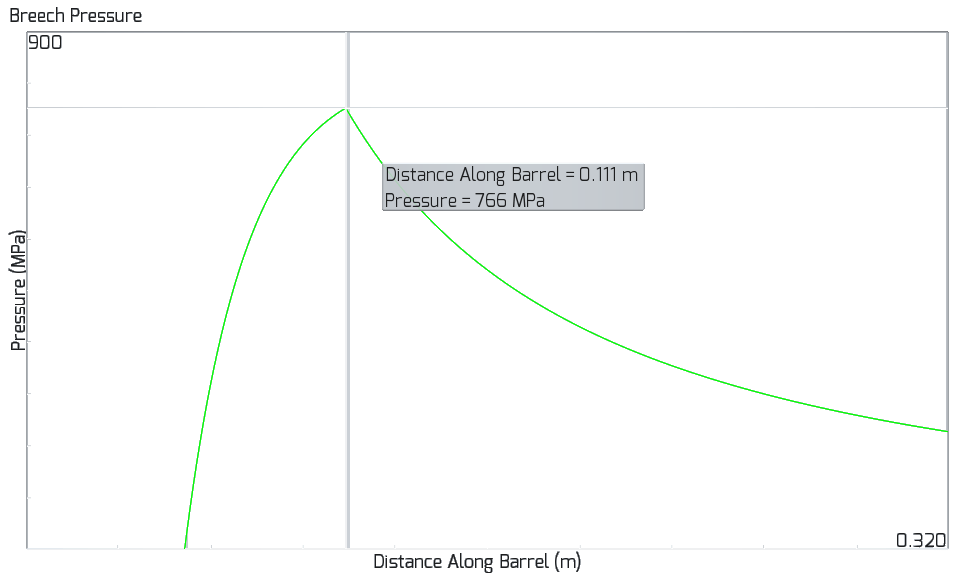 . is measured by reducing the “barrel length” parameter in game until the “propellant burnout is not contained” error message pops up. multiple measurements are taken after the burnout point.
A common data reduction trick for this sort of situation is to take the log of both sides to yield:
![\log(p_b) - \log(p_{b,c}) = -\gamma [\log(x+l_1) - \log(x_c+l_1)]](https://s0.wp.com/latex.php?latex=%5Clog%28p_b%29+-+%5Clog%28p_%7Bb%2Cc%7D%29+%3D+-%5Cgamma+%5B%5Clog%28x%2Bl_1%29+-+%5Clog%28x_c%2Bl_1%29%5D+&bg=ffffff&fg=000&s=0&c=20201002)
The

With the

As the chamber free volume should be the volume not occupied by propellant within the chamber, i.e.:

Naturally, this causes a fundamentally irreconcilable contradiction in that the chamber of every gun in CoaDE is simultaneousely both fully full and fully empty, depending on whether the module design graphics and generated 3-d model, or the pressure-travel curves are accepted as ground truth.
Then what is actually being modeled in game?
If the 3-d model and 2-d graphics are changed to be exactly twice that chamber volume, this can reconciliate the specified chamber free volume, which preserves the interior ballistics, and the need to physically accommodate the required mass of propellant within the chamber. Put it another way, as more propellant is loaded into a gun, what effectively happens is that the game adds the equivalent volume behind the projectile, i.e. the chamber is always exactly half full, the load density 

Pedantics aside, the practical influence of this error is that it unintentionally introduced a dependence of the chamber “free” volume on the amount of propellant loaded. While it may seem at first that this is in favor of guns, detailed analysis indicate otherwise. It so-happens that the load density is actually a performance critical parameter for conventional firearms.
To illustrate this, the underlying interior ballistics model has been implemented as a computer program. Trial runs have been conducted to verify the conformity of this program: with parameters reverse engineered from the game, the results demonstrates satisfactory agreement with in-game module designer.
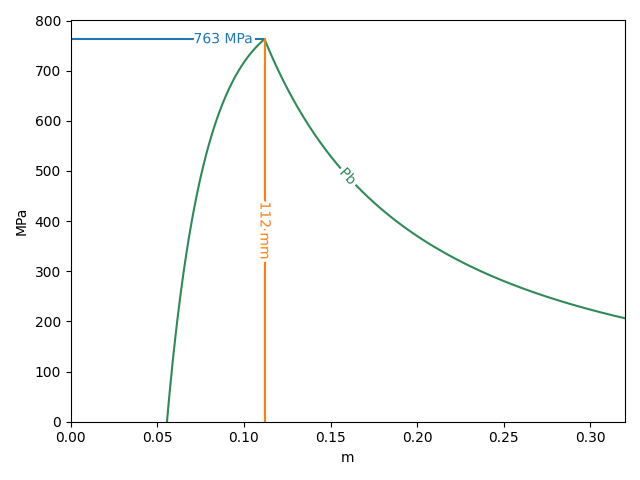
A numeric solver is written to solve for the propellant web thickness required to achieve a certain peak pressure, for a given set of gun parameters (caliber, chamber volume, propellant type and shape, propellant mass, projectile mass). With the web found, the required length to achieve a certain muzzle velocity can then be solved.
This effectively solves the “inverse-problem” for ballistics design with the free variables as gun parameters and the performance (peak pressure, muzzle velocity) held constant. On this basis, different guns may be compared to appreciate the relative merit of their designs.
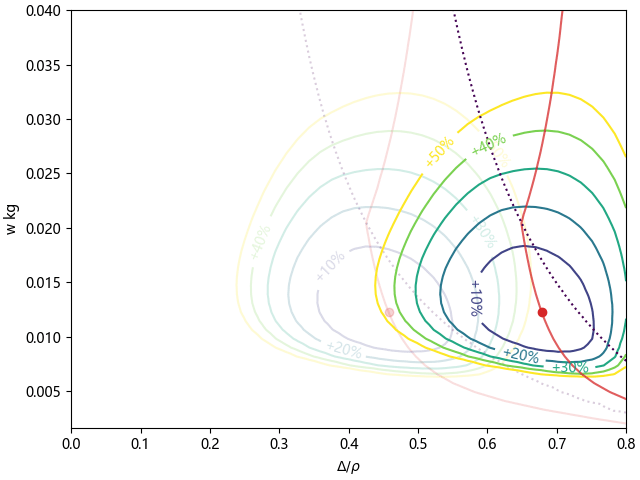
Let’s use a specific example. Take the “22 mm Turreted Cannon” in game. We take the performance characteristics (1370 m/s muzzle velocity, 239 MPa peak breech pressure) as a constant and vary the chamber volume and charge mass. For each condition, the propellant web is solved as a dependent variable, controlling for the specified peak breech pressure. The resulting bore length (chamber + barrel) required to attain the performance is plotted normalized to the best solution found. This yields a Serebryakov guide graph of the form:
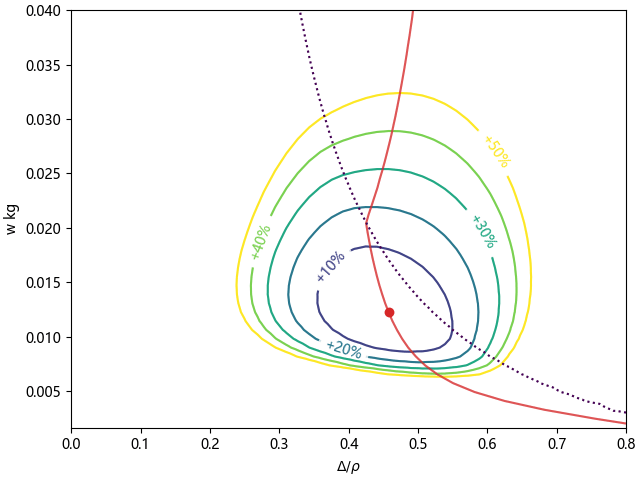
Two additional lines have been plotted for convenience: the dotted, black line denotes solution where the burnout point is contained within the barrel. Such solutions are naturally desirable for its consistency of performance and economy of propellant. The solid red line indicate solutions that are locally optimal for a given propellant load, or 
If the performance characteristics were to be varied, for example — if the targeted muzzle velocity increase to 1.5 times that of the current design (left), the new contour moves “upwards”, towards heavier weight of charge. On the other hand, if the targeted muzzle velocity were to be reduced to 0.5 times, the new contour moves “downward”, towards lower weight of charge. Observe that in all of these cases the optimal solution is in the vicinity of 
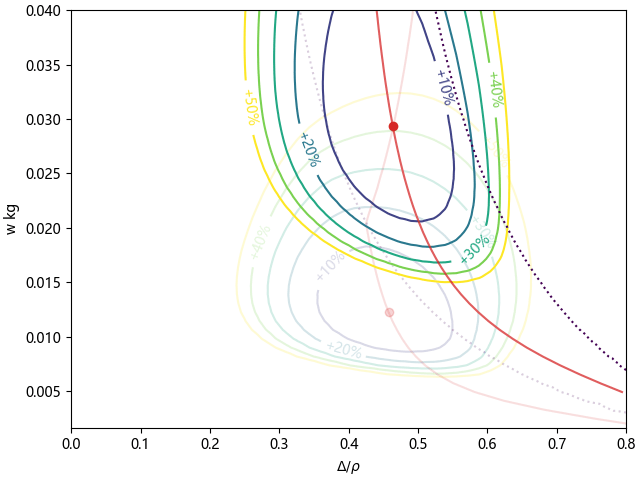
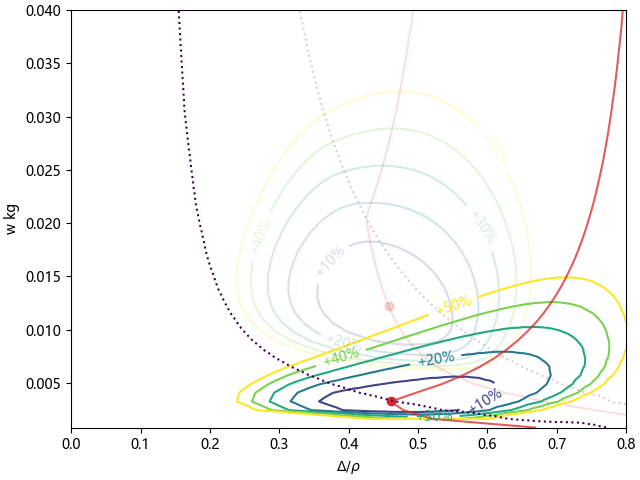
This example shows that within reason, the load density at which guns are optimal is not greatly influenced by the variation of targeted velocity.
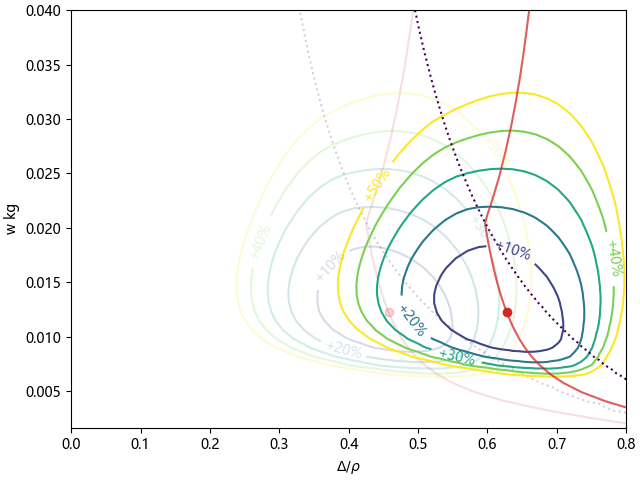
The influence of targeted breech pressure on the globally optimal solution is almost orthogonal to that of muzzle velocity, see below. The plot on the left illustrates an increase in targeted pressure to 1.5 times causing the optimal solution to also shift towards higher load density, or a more densely loaded chamber. On the right, a decrease in targeted pressure to 0.5 times the original value causes the optimal solution to shift towards lower load density.
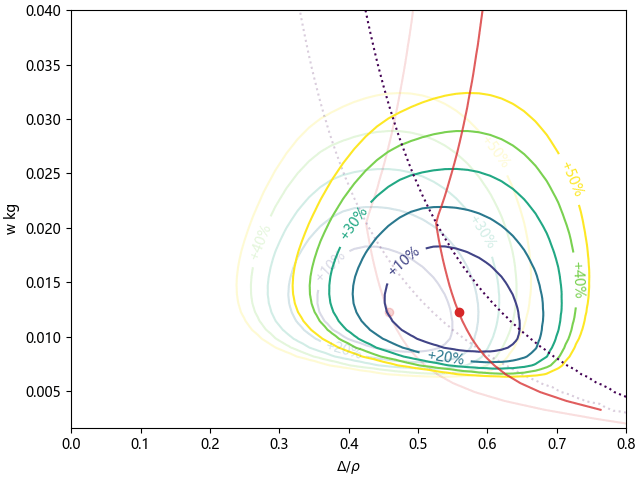
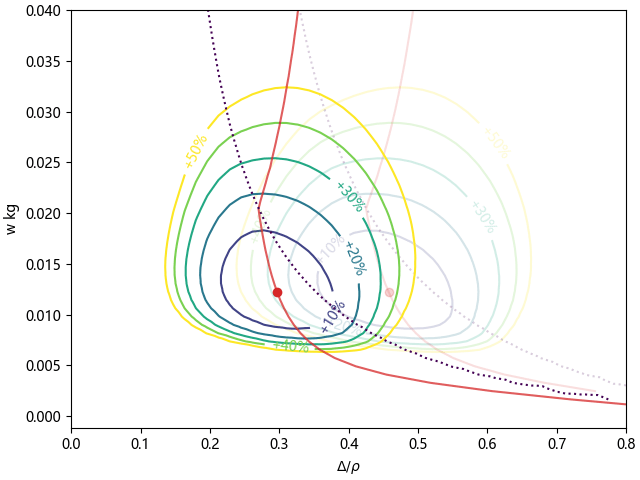
Expanding the sweep upwards to 2 and 2.5 times the targeted pressure, the issue that this poses become more apparent. Designs developing this level of pressure is not considered abnormal in today’s age2, and yet at twice the pressure, solutions constrained to a fixed load density of
Moving from the “22 mm Turreted Cannon”, the optimal solution for all stock conventional gun designs have been calculated, and is tabulated below. For each entry, results in the top row optimizes the bore length, the bottom row, the barrel length. For this particular interior ballistics model, the two optimal targets are found to be close enough that for practical purposes one may safely reference the two interchangeably.
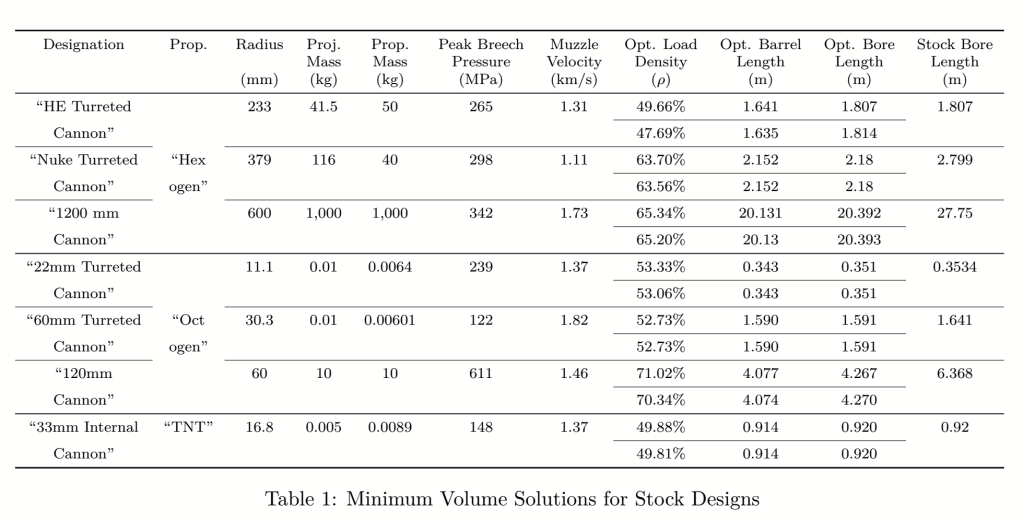
The effect of a fixed load density is evident even for this small section of designs. Higher pressure pieces have been strongly affected, notably the “Nuclear Turreted Cannon” (+28%), the “1200 mm Cannon” (+36%!), and the “120 mm Cannon” (+49%!!), in increasing order of severity. It should be noted that the influence of pressure upon the optimal solution is relative to other design parameters of a gun, as for example a 265 MPa design pressure causes the optimal load density to be lower than 50% 
In conclusion, under the constraint imposed by the “conventional gun” module designer, a peak breech pressure higher or lower than a certain range of value is artificially punished in terms of length. This is especially frustrating, since many times the increase of peak breech pressure is precisely for the reason of cutting down the bore length. On the other end of the spectrum, low pressure, “launcher” type designs are also punitized with unnecessarily long and heavy bores for a given performance, or a reduced performance for a given form factor and weight.
Viewed another way, the effect of these factors are to encourage guns to be designed with an optimal load density close to 50%
However, I am not going to give credit to the game for simulating this, as this is both an unintentional constraint, as well as that in real life, much work has gone into ignition engineering (as well as providing impetus for Electrical-Thermal-Chemical work) to raise this limit for more important direct fire pieces, notably tank guns, to the point of making this a non-decisive-factor for large caliber work. In my opinion, similar levels of effort should be reflected in guns designed to arm military spaceships, however dire the situation is for the military-industrial complex of the Republic of the Free People and abroad.
Erroneous and Unverifiable Propellant Data, and the Trappings of From First Principles.
The propellant data included in the game heavily under represents the energy density as compared to their values in real life, and does not appear to have basis in reality. Secondary to this issue, the module designer in game models the grains as neutral burning, to the detriment of performance.
As a reminder, the relevant propellant properties as they relate to interior ballistics are their propellant force, the burn rate coefficient(s), and the adiabatic index of the gas product. For this interior ballistics formulation, the shape of the propellant is factored in via the shape factor, which is also required to know.
The effect of shape factor in this ballistics formulation is best illustrated graphically. The following plot shows the depression of pressure curve as the propellant web is increased for gun designs with regressive (left, 


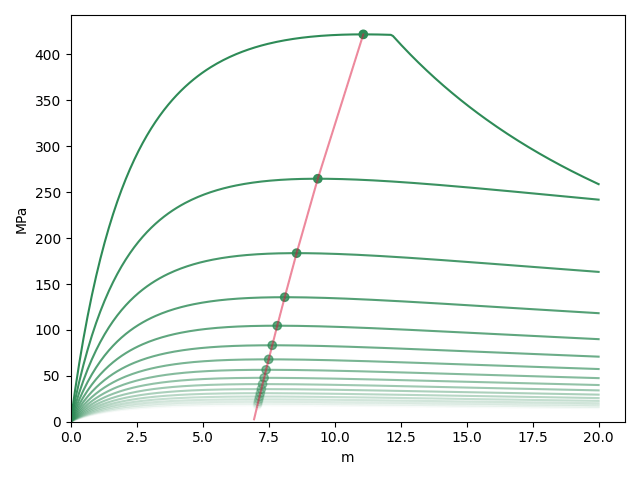
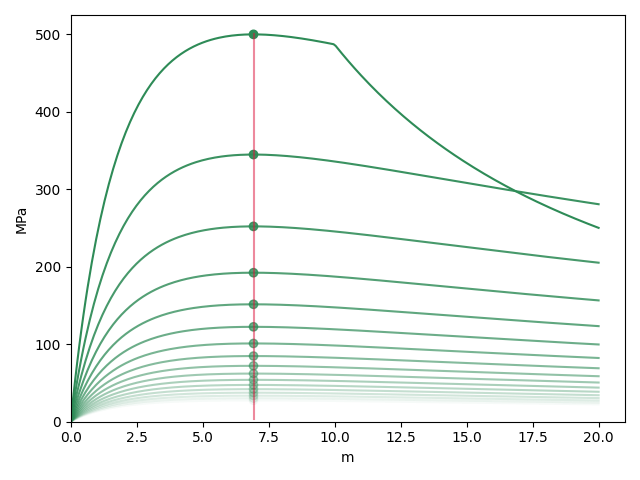
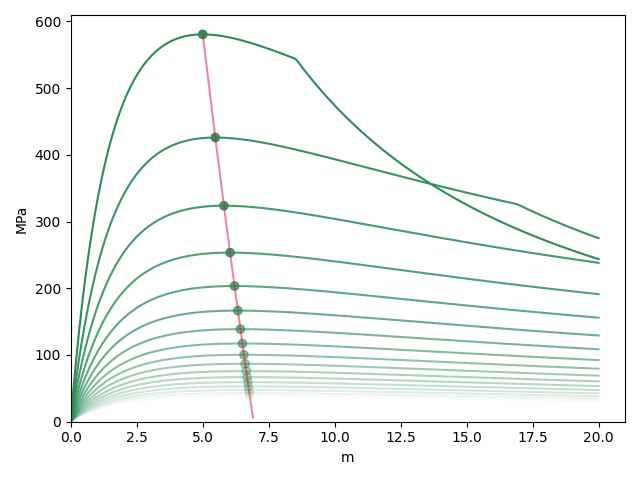
For regressive grains, the point of peak-pressure, is shifted towards the muzzle as the propellant web is decreased, and as the pressure is increased. The effect is the opposite for progressive grains. The location at which peak pressure occurs is not affected for neutral burning grains. Of note, this only applies for cases where the propellant peak pressure point occurs before burnout.
This experiment is repeated in game, and the location of peak pressure point is found to be static, i.e. 


The burn rate coefficient can be determined through the projectile’s velocity at burnout, 

Suppose we have two gun designs that are otherwise the same except for the propellant web, of the relation 

This allows the value of the central ballistics parameter to be recovered by linear regression. With

This allows all the relevant thermalchemical properties of the propellant to be reverse engineered using only information present in game and the knowledge of the underlying interior ballistics model. For completeness’s sake, this is repeated for all gun propellants in game, with the result presented below:
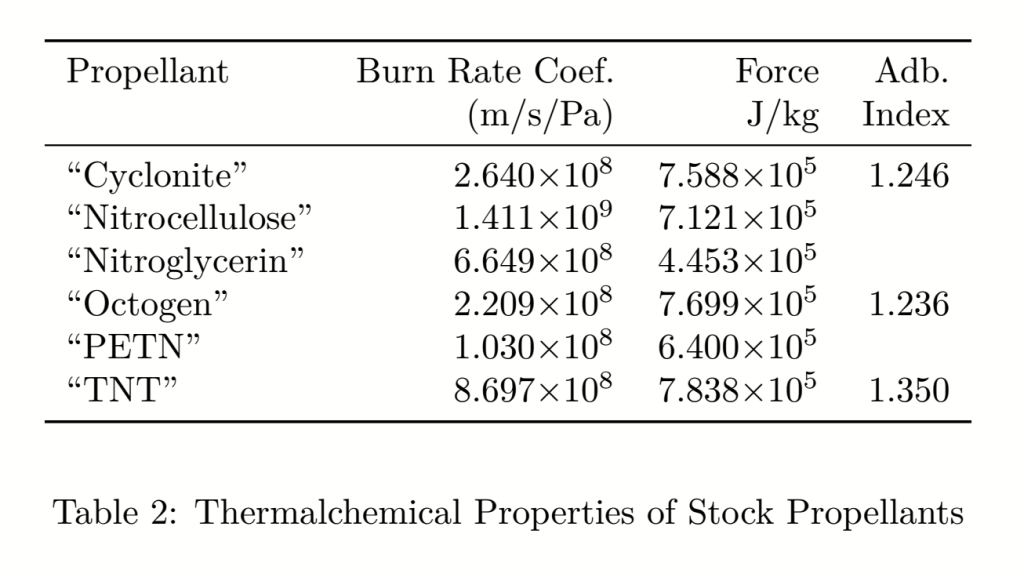
It is immediately obvious that the propellant force used in game is low as compared to gun propellant used in the real world. For example, while the most energetic propellant in game develops barely 0.78 MJ/kg, existing literature reports a value of 1.12 to 1.15 MJ/kg for JA-2, a triple based propellant used for tank rounds developed in the 1980s. More traditional formulation, such as the M1, a single base propellant that still finds use in artillery, develops a force of around 0.91 MJ/kg.
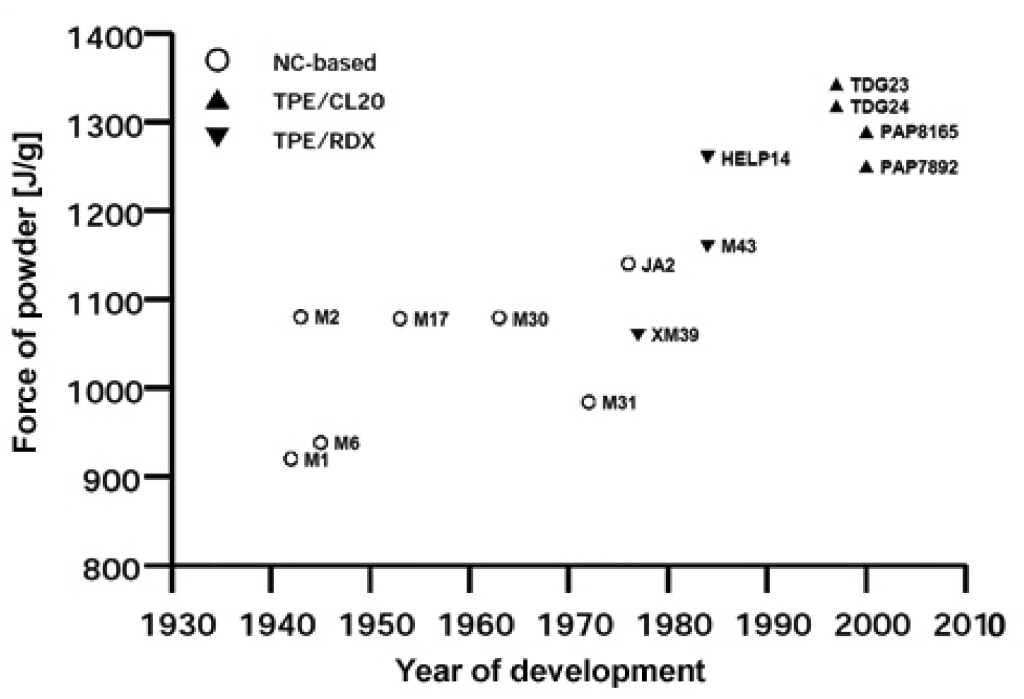
It is only fair, however, that the stock propellants be compared to their real life counterparts. This presents several problems: while propellant thermalchemical data for straight nitrocellulose, cyclonite (HMX), and octogen (RDX) are available from literature, none are available for pure nitroglycerin, PETN, and trinitrotoluene (TNT) for I hope frankly obvious reasons. Additionally, data for nitrocellulose is only available up to 13.5-13.6% nitration, as more heavily nitrated nitrocellulose tends to detonate violently. The “nitrocellulose” as present in game is of the tri-nitrated variety, with a nitration level in excess of 14%. This necessitates computing the performance data for a fair comparison.
Computing the thermalchemical properties of propellant is possible from first principles, but the procedure involved is highly complex. The propellant force is derived as the product of the molar mass of the resulting gas species, and the isochoric equilibrium temperature of the system. The resulting equilibrium is somewhat dependent on the density to which propellant is loaded, but the value does not vary too much when the load density is low.
Historically, this required proprietary software, such as the BLAKE and the related TIGER program. Fortunately, the commonly used and widely available chemical equilibrium package CEA, primarily used in the field of rocketry, is able to solve isochoric equilibrium problems. For this article, the author developed a program to interface with CEA, feeding the required parameters and processing the result to parameters relevant to interior ballistics.
The computed values for stock propellant according to their in-game composition, using in-game enthalpy data when unavailable (both sourced from “Combustables.txt”), is tabulated below. This reinforce the conclusion that the propellant force, as seen in game is low, even when compared against their real life counterpart, as pure substances.
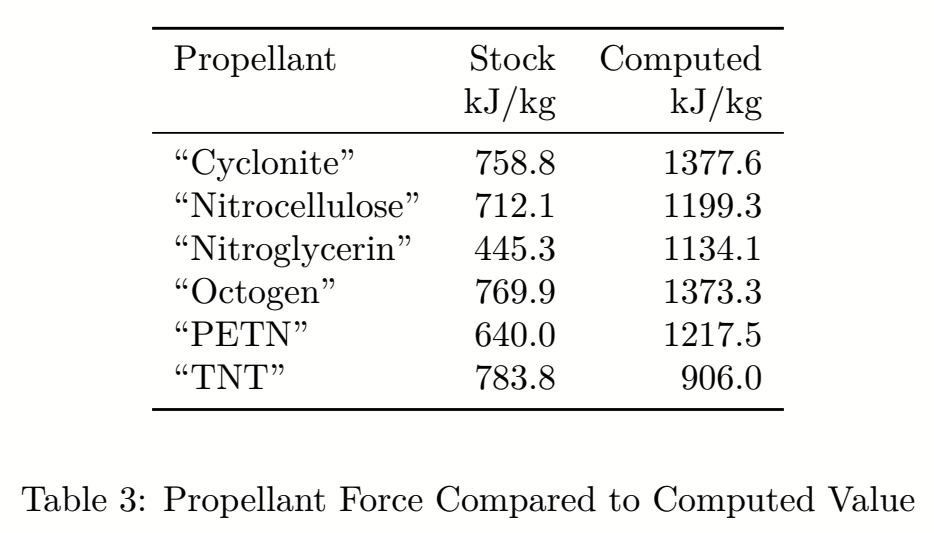
The underlying reason of this undervalue seems to be the datafile “ChemicalReactions.txt”, which specifies the product and activation energy of the decomposition reaction for these propellants. For example, the decomposition product of “Octogen” is specified as:
- 4 moles of CO
- 4 moles of H2O
- 4 moles of N2
per mole of Octogen. Compare this to the computed equilibrium composition of:
- ~4 moles of N2
- ~3 moles of CO
- ~2.8 moles of H2O
- ~1 mole of H2
- ~0.9 mole of CO2
- ~0.2 mole of OH radical
- ~0.1 mole of H radical
- other rarer species.
The amount of gas product has been correctly represented, but the water-gas balance skews decisively towards water as compared to the computed one. Recall that water molecules have higher specific heat than other molecules present. This skew towards water likely causes the reaction temperature to be under-estimated, potentially resulting in excessively low propellant force.
However, due to many other potentially confounding issues associated with this game’s handling of thermo-chemistry, the root cause cannot be conclusively determined without additional knowledge on the implementation. If this is ever determined in the future, additional information will be added here.
As the propellant force is a quantity that directly relates to how much work can be extracted from a given weight of propellant, this directly harms the performance of conventional gun as modeled in game. Consider the limiting case where the projectile is given an infinitely long barrel. The limit to the velocity that can be reached by the projectile is:

The effect of a lower 
This is most apparent if one examine the “120 mm cannon” in game. This is obviously a stand-in for the real life 120 mm tank guns. The characteristics of the 120 mm tank gun firing the APFSDS round M829A1 is as follows:
- Projectile: 120 mm, 7.1 kg
- Propellant: JA-2, 7.51 kg at 1140 kJ/kg, loaded to 0.77 g/cc
- Bore: 4.75 m of travel, 9.75 liter chamber
- Performance: develops 1650 m/s at 505 MPa peak breech pressure
Compare this to the “120mm cannon” in game:
- Projectile: 120 mm, 10.0 kg
- Propellant: “Octogen”, 10.0 kg, loaded to 0.95 g/cc
- Bore: 5.9 m of travel, 5.26 liter chamber
- Performance: develops 1460 m/s at 611 MPa peak breech pressure
The performance compares much less favorably even as the shot to charge mass ratio is close, as the gun develops less muzzle velocity, at a higher pressure, while also requiring a longer travel (although as noted in the previous section, this may be optimized down to 4.07 m if the load density was not locked).
However, if the proposed force value for Octogen is adopted, the design achieves the same performance with only 2.713 meters of projectile travel, making the original design 117% overlong. (Curiously, by pure coincidence this also brings the optimal load density back close to 50%.)
Finally, some comment on the treatment of other propellant thermalchemical properties that are less consequential. These information are not set in the game’s data file, and thus had to be estimated somehow from the limited thermalchemical information present in game.
Regarding the adiabatic index, the values in game are in line with ballistic experience, and the values appear to be reasonable. However, as the methodology to derive these are not known, it is difficult to assess the reliability of the underlying method. Regarding the propellant burn rate coefficient, as far as I am aware there is no reliable method for estimating this parameter, given the complex nature of the underlying phenomenon. The values are in the right order of magnitude, but as with above, the methodology cannot be assessed as it is entirely unknown.
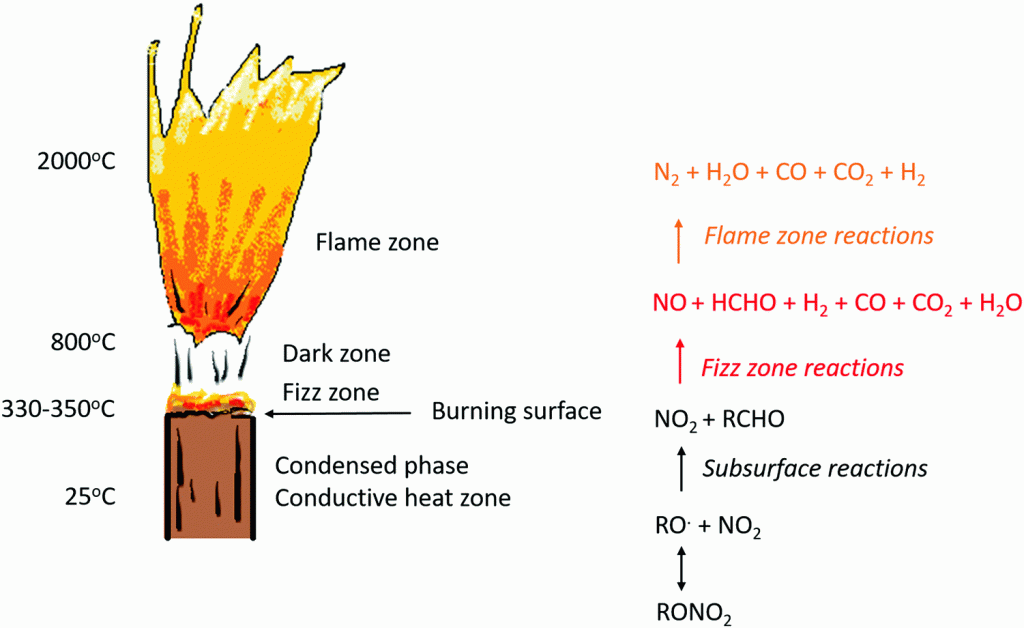
Overall, in my humble opinion, this section should have been entirely unnecessary had QSwitched broke with the obsession to derive complex thermalchemical properties from first principles, while also reinventing the methodology at the same time. This approach runs into a literal wall when conventional guns are being modeled, as much of the propellant thermal properties are either highly complex to calculate, or have simply eluded first principle calculation. This is further exacerbated by QSwitched’s apparent misunderstanding of what material is suitably used as gun propellants v.s. explosives, leading to an overly-wide selection of material that are not suitable for use. Naturally, propellant thermalchemical information would not be available for these. So from QSwitched’s perspective, there seems to be little option but to calculate properties from first principles.
Meanwhile, published parameters are readily available on existing service propellant, which spans the gamut from single-based formulations, largely nitrocellulose, to double-based nitrocellulose-nitroglycerin formulations, up to triple-based nitroguanidine, and nitroamine propellant. Although these are specific formulations tailored to the service they serve, generic names can be used to characterize these if so desired. This struck me as both a more prudent and more convenient approach to the problem that would greatly enhance the realism of the game. I frankly do not understand the reasoning here.
Conclusion
Much of what has to be said has already been said. Conventional gun performance has been much maligned by the combination of error in the model as well as in the propellant data.
Throughout the article, I have spared no effort to “dot the i and cross the t”s, and the article represent my best faith effort at reconstructing and deconstructing the “Conventional Gun module” in game. If this helps clear up some misconception as have been created by the game, then my effort has not be in vain. So long until next time then.
- Of note, 0-dimensional interior ballistics systems in generally tends to formulate the propellant burn rate with respect to the average pressure behind the projectile, while the particular formulation in Galucci and Jacobson’s book follows J. Corner, and is instead formulated with propellant burn rate proportional to breech pressure, the latter of which can be substantially higher for high performance pieces.
This disagreement reflects differing view on the behavior of propellant grains in bore, where the former view assumes propellant grains being significantly accelerated by the gas flow while combusting, while the latter assumes the opposite. It can be fairly argued, in light of modern two-phase flow research, that either case can be valid depending on the specifics of charge design — loose, granular grains in guns with a large load of charge is more likely to behave like the former view, while long, tubular grains in guns with a light load of charge is more likely to behave like the latter view.
The effect of which is to cause different peak pressures to be predicted for a given propellant arch width, but does not affect the pressure-time curve predicted when controlling for the same pressure. Put simply, it is only a matter of concern if exactly matching a real life gun design, down to the charge design level, is required. ↩︎ - 2.5 times the pressure brings the peak breech pressure to ~600 MPa. As a point of reference, the peak breech pressure developed within a 120 mm Rheinmetall Rh-120 smoothbore tank gun firing the M829 APFSDS round is ~500 MPa in nominal operations. The same gun has been steadily improved, and nominal pressure in the range of 600-700 MPa has been reported. Note that this is with a generous service reserve, as the barrel itself is physically capable of taking pressures in the range of 800 MPa before failing. ↩︎

 The Meandering of a Ballistics Oriented Mind
Leave a comment